
Why we give first to our own…and why the circle can't stop there
The first form is the oldest one…kin altruism, the sacrifice we make for our own people. Kin altruism is the training ground of love — the first classroom where we learn that someone else's need can outrank our comfort. But a tribe that never widens its circle stops being a family and becomes a fortress. There are two ways to get this wrong. The skeptic says helping family is just genes looking after themselves — selfishness in a nicer coat. The universalist says preferring your own is a kind of prejudice. Both miss the point. One cheapens the gift; the other denies the giver a place to learn it.
Where It Starts
In 1964 the biologist W. D. Hamilton gave science a way to explain why living things sacrifice for their relatives. His insight, now called inclusive fitness, hold that a costly act can pay off when it helps those who share our blood. J. B. S. Haldane is often credited with the quip that he would lay down his life for two brothers or eight cousins. Social psychologists later tested the idea in people. When the stakes were life and death, participants were far more willing to help close kin than distant relatives or strangers; on everyday favors, the gap narrowed.
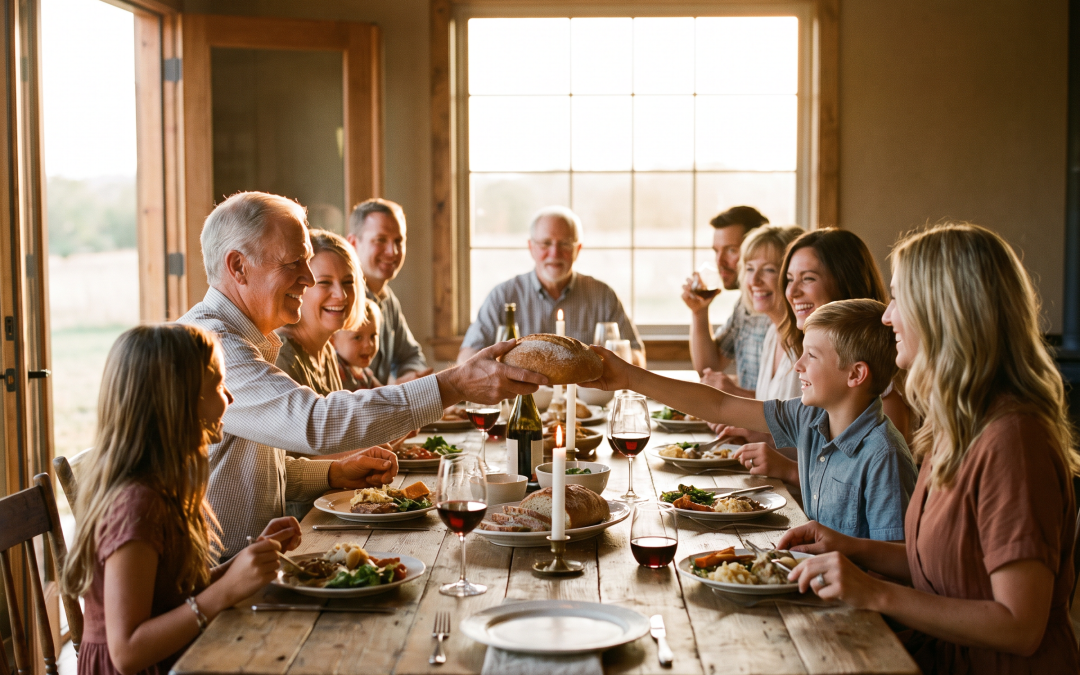
Science calls it inclusive fitness. I call it the first classroom. The home is where a child first watches a father skip a meal so the kids can eat, or a mother sit beside a sickbed until morning, or a child shred their ice cream with a sibling because there isn’t enough to go around. Before anyone learns to love humanity in the abstract, they learn to love the faces at their table. That is not a flaw in the design…it is the quintessential design of humanity and Christ’s mission for us all.
Skeptics often overreach, explaining where a behavior came from in order to explain it away. Hamilton's math can tell you whom we are inclined to help; it cannot tell you why a widow keeps setting a place for a husband who is never coming home or why parents lie to their children and give them more of their share.
You learn to love the world by first learning to love the ones at your table.
After nearly three decades in uniform, I can tell you that the term "band of brothers" is not a figure of speech. Something happens to people who train together, bleed together, and bury friends together. Their sense of self and their sense of the unit begin to merge. Researchers call this identity fusion, and the fused will make the same sacrifices for the group that people ordinarily reserve for family. Strangers from different states, faiths, and backgrounds become kin by covenant rather than by blood…creating lifetime friendship and family.
Ask a veteran what they miss most, and it is rarely the deployment…it is almost always the people.
The Shadow: When the Circle Closes
Every strength casts a shadow, and kin altruism casts a long one. Social psychologists discovered decades ago how little it takes to make us favor our own. Divide strangers into groups on the flimsiest pretext, and they will start tilting rewards toward their side (Tajfel & Turner, 1979). Marilynn Brewer's work adds a crucial distinction: loving your in-group does not require hating the out-group (Brewer, 1999). Favoritism and hostility are different things. But under threat, competition, or fear, the first can slide into the second.
You have seen the slide. "We take care of our own" becomes "we protect our own from accountability." The family business that hires the incompetent nephew. The department that closes ranks around a bad actor. The congregation so warm to its members that a visitor never gets past the narthex. This is where altruism needs morality. Loyalty is good; loyalty without conscience becomes complicity. Loyalty without conscience isn't loyalty…it's a cover-up with a handshake.
Who Is My Brother?
Scripture does not scold kin altruism. It commands it. Saint Paul says the one who will not provide for his own household has denied the faith (1 Tim 5:8). He also gives the order of our duty: do good to all, especially to those of the household of faith (Gal 6:10). Near first…but never only.
Then Christ does something startling. Told that His mother and brothers were waiting outside, He asked, "Who is My mother, or My brethren?" and pointed to those around Him: whoever does the will of God is His brother, sister, and mother (Mark 3:33–35). He was not abandoning His family; He was redrawing the borders of the tribe. When a lawyer tried to narrow his obligations by asking, "Who is my neighbor?" (Luke 10:29), Christ answered with a Samaritan — the outsider who became kin through mercy. Ruth said it to Naomi long before: thy people shall be my people (Ruth 1:16).
The Church has always lived this way, welcoming each of us as brother or sister. A godparent stands at the font and takes a vow for a child who is not their own by blood but is still family within the Christianity. The Church is a tribe with an open door…a family that grows by adoption, because that is how each of us arrived. Christ welcomes us…with all our flaws and sins…with all our scars and egos.
Still Searching…
Kin altruism is about caring for those you love…family or adopted family. If you ever played the game “6 (or 7) degrees of Kevin Bacon” then you already know, we are all connected to each other through 6 degrees of separation. Call one person from your tribe — not to reminisce, but to check on them. Then walk into a parish on Sunday…and stay for coffee hour. If your you lost your tribe, find it again, and love them as Christ loves you.
We were made for a purpose. The miracle is that God keeps making the tribe stronger..if you follow him.
So…who is your tribe? Kin altruism is only the first of the forms altruism takes, and each one has its own shadow. What kind of altruist are you? Take the survey and find out — and join the list for the next part of the series.

References
Brewer, M. B. (1999). The psychology of prejudice: Ingroup love or outgroup hate? Journal of Social Issues, 55(3), 429–444. https://doi.org/10.1111/0022-4537.00126
Tajfel, H., & Turner, J. C. (1979). An integrative theory of intergroup conflict. In W. G. Austin & S. Worchel (Eds.), The social psychology of intergroup relations (pp. 33–47). Brooks/Cole.
Your blog is a source of motivation, always encouraging readers to explore new ideas and confront complex problems with creativity, making it a vital resource for anyone seeking knowledge.
r-group.design